


Short answer: yes. Fortnite on PC requires Easy Anti-Cheat (EAC), and Epic owns the company that makes it. On Windows, EAC relies on a kernel driver that starts when you launch the game and stops when you close it.
The anti-cheat is only one part of it. Epic also has strict written rules, a ban policy where a second offense is permanent, hardware requirements for every PC tournament, and a long record of suing cheaters and cheat sellers.
Here is the whole picture as of November 2026: what Fortnite runs, what the rules say, what the penalties are, how appeals work, and how to fix the anti-cheat errors players run into most.
What Fortnite Uses
Easy Anti-Cheat, made by Epic
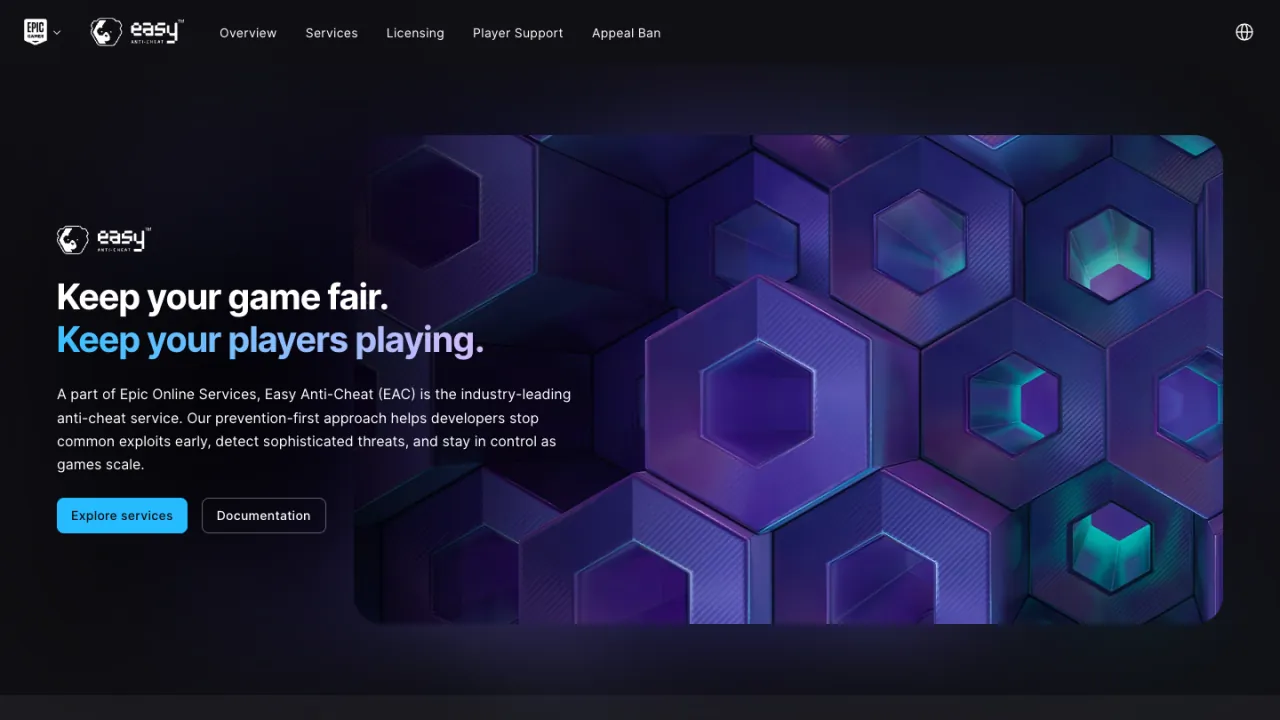 Easy Anti-Cheat's website describes it as "a part of Epic Online Services". Note the "Appeal Ban" link in the top menu.
Epic's help center lists Easy Anti-Cheat as required to play Fortnite on PC. Epic bought Kamu, the Finnish company behind EAC, on 8 October 2018. Fortnite already used EAC before the deal.
On how it runs, Epic was direct in an October 2026 post: "On Windows, we rely heavily on a kernel driver to protect the games. This driver isn't always on, it starts when a game is launched and stops when the player exits."
Kernel level means the driver runs with more privileges than normal programs, which lets it see software a regular program couldn't. EAC's own site adds two details: it doesn't run at boot or in the background, and it collects hardware identifiers. It also points out that EAC doesn't decide bans itself. The game's publisher does, and for Fortnite that is Epic.
What about BattlEye?
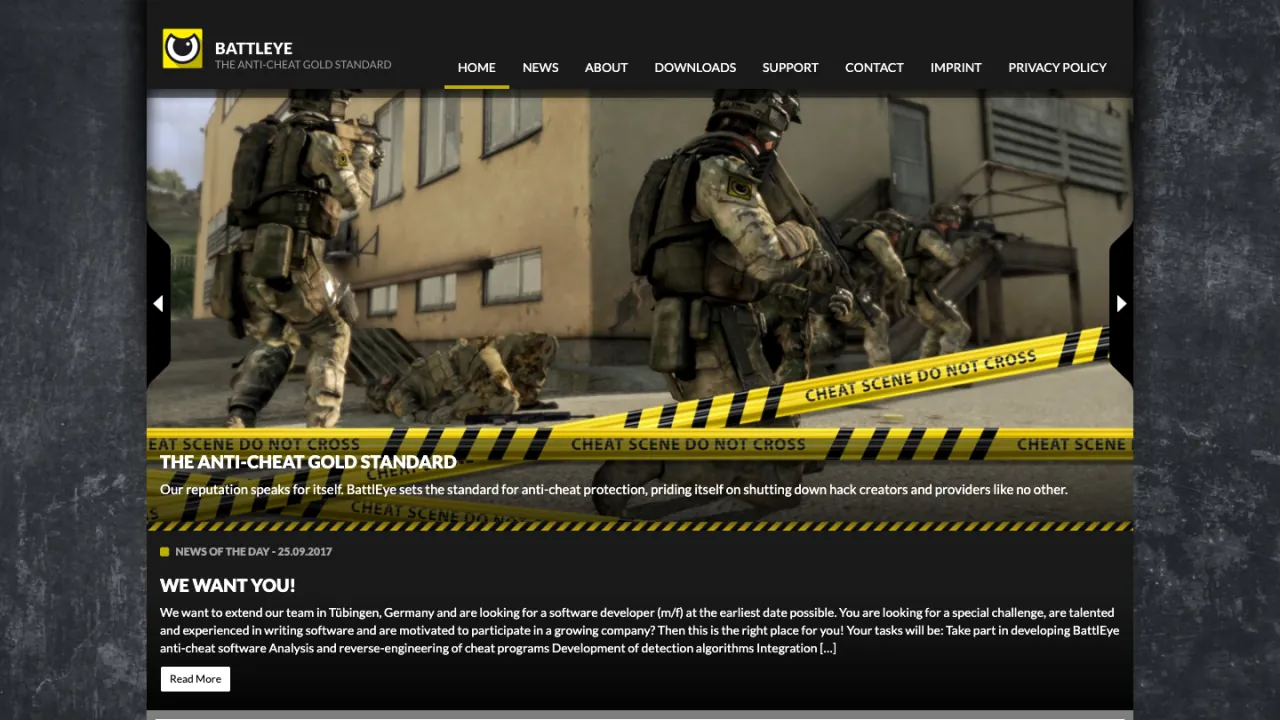 BattlEye's website. BattlEye also uses a kernel-mode driver that only runs while a protected game is open.
For years, Fortnite also shipped with BattlEye alongside EAC. Whether it still does is not clear:
- Epic still hosts BattlEye troubleshooting pages for Fortnite, and its help page for the IS-MF launch errors mentions both services.
- In June 2024, community trackers reported that Fortnite had dropped BattlEye and now uses EAC by default.
- Epic has not published a statement either way.
If your Fortnite install still includes BattlEye files or services, the fixes later in this guide cover them.
What Epic's Rules Say
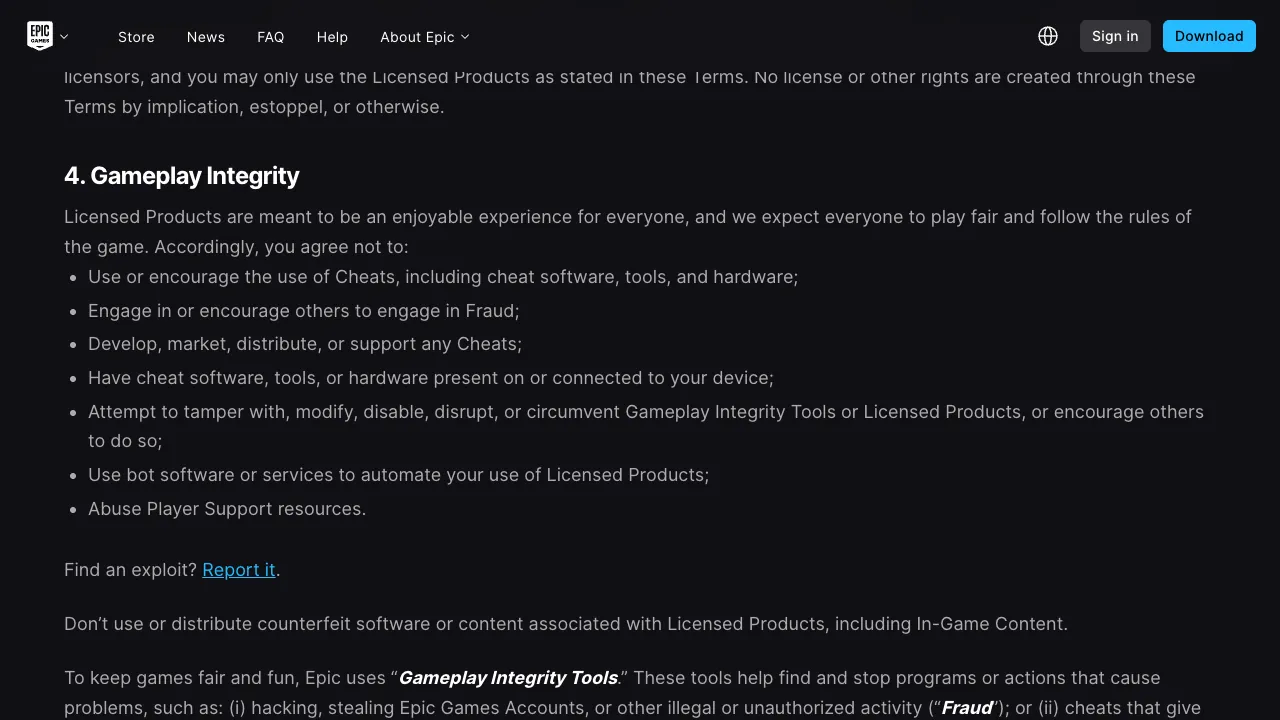 Section 4 of the Epic Games Terms of Service, "Gameplay Integrity".
Epic's Terms of Service (last updated 27 May 2026) define Cheats as "cheats that give unfair advantages, like bots, hacks, add-ons, malware, scripts, or mods not approved by Epic." In Section 4, players agree not to:
- "Use or encourage the use of Cheats, including cheat software, tools, and hardware"
- "Develop, market, distribute, or support any Cheats"
- "Have cheat software, tools, or hardware present on or connected to your device"
- "Attempt to tamper with, modify, disable, disrupt, or circumvent Gameplay Integrity Tools"
Three more lines in that section are worth reading closely:
- Epic can act "without prior notice."
- "It will not be a defense, however, to say that you had not yet used the devices or tools." In other words, having cheat software on your PC is already a violation.
- Epic "need not and will not reveal to you how its Gameplay Integrity Tools work or what specific devices or tools Epic detected." Don't expect to be told what triggered a ban.
The Penalties
Epic changed its cheating penalties in February 2025. Under the current policy:
| Offense | Penalty |
|---|---|
| First cheating offense | One-year matchmaking ban. You can still log in and chat, but can't matchmake or spectate |
| Second cheating offense | Lifetime ban |
| Cheating in a tournament | One-year matchmaking ban, an immediate lifetime competitive ban, and possible loss of past winnings |
| Selling cheats | Lifetime ban |
| Teaming with a cheater in a tournament | Competitive ban of at least 28 days |
| Using restricted hardware such as a Cronus Zen | Warning, with a permanent ban possible if you try to get around it |
When the new policy launched, Epic also lifted lifetime cheating bans that were more than a year old.
Epic doesn't publish ban totals. The only recent figure comes from a June 2025 lawsuit against a cheat seller, in which Epic alleged tens of thousands of bans tied to that seller's cheats.
 Bans hit your whole Epic Games account, not just one Fortnite season.
How appeals work
Appeals go through Epic's Sanctions and Appeals portal, using the Sanction ID from the email Epic sends you. You can file one appeal per eligible sanction, you can't cancel it once filed, and you can appeal while the sanction is running. Epic says Player Support can't file an appeal for you. Easy Anti-Cheat's site also links to an appeal page, but for Fortnite the decision belongs to Epic.
Tournament Requirements: TPM, Secure Boot and IOMMU
Epic now checks your PC's security settings before you can play competitively:
- From 27 February 2025, Windows players needed TPM 2.0 and Secure Boot for tournaments that require Account Level 350 or higher, such as FNCS and cash cups.
- From 19 February 2026, Epic expanded this to every Fortnite tournament on PC, and added a third requirement: IOMMU. Epic said PCs compatible with Windows 11, around 95% of PC players, most likely meet the requirements already.
According to coverage of the change, normal matchmaking isn't affected. If you hit one of these errors while trying to enter a tournament, Epic's fixes are:
| Error | What to do |
|---|---|
| TPM Attestation failed: Unable to verify Secure Boot | Update your BIOS, turn on TPM and Secure Boot, and make sure Secure Boot isn't in Audit Mode |
| PCR mismatch | Same steps as above |
| IOMMU is required to play | Turn on VT-d (Intel) or AMD-Vi (AMD) in your BIOS |
Epic Takes Cheaters to Court
Epic is one of the few publishers that regularly goes after individual cheaters and cheat sellers, often through the courts:
| When | Who | What happened |
|---|---|---|
| 2017 | People linked to the Addicted Cheats site | Epic sued. One defendant settled and accepted a permanent injunction |
| 2017–2021 | A 14-year-old cheater and YouTuber | Settled under seal in February 2021 |
| 2024–2025 | Sebastian Araujo | Banned in June 2024 after 839 cash tournaments. Sued in December 2024. In June 2025 a default judgment ordered him to pay about $175,000, which Epic said it would give to charity |
| June 2025 | Ediz Atas ("Vanta Cheats") and five others | Federal lawsuit including anti-circumvention claims under the DMCA |
| July 2025 | A cheat seller and a player behind DDoS attacks | Both were banned and posted public apologies |
| February 2026 | A player who cheated and ran DDoS attacks | Permanently banned across Epic's services, with a public apology |
| July 2026 | A seller of DMA cheats | Barred from selling cheats in the future |
Competitive play has had its own cases. In early 2025 Epic gave a lifetime ban to a player it said had shared an account to qualify for FNCS, and sent his winnings to the charity Child's Play. Epic also gets it wrong sometimes. A pro banned for teaming with a cheater in January 2025 was cleared three days later. And at FNCS Major 1 in April 2026, players including Bugha were disqualified for using drop calculators. Epic reversed the disqualifications, admitted "there is legit confusion" over the rules, and then banned tools that read live game state.
Fortnite on Linux and Steam Deck
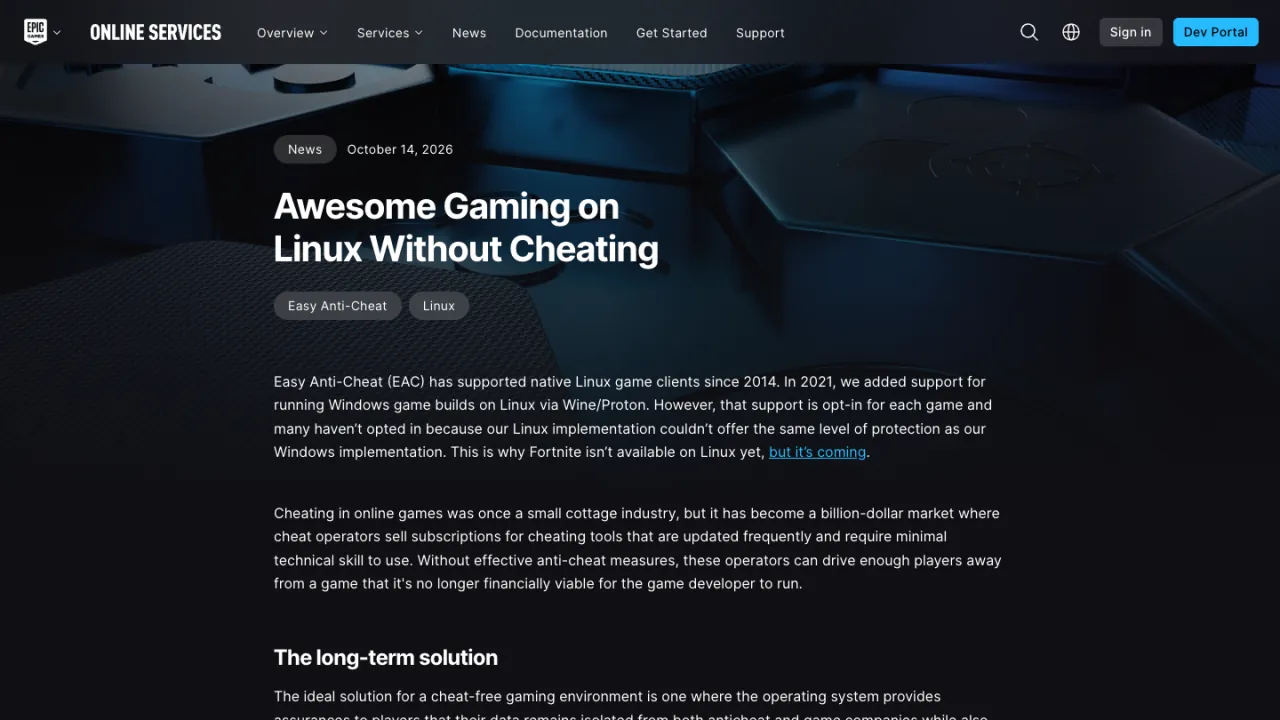 Epic's 14 October 2026 announcement of EAC Linux v2.
Fortnite still doesn't run on Linux or Steam Deck, and the reason is anti-cheat. In 2022, Epic CEO Tim Sweeney said Epic didn't have confidence it could "combat cheating at scale under a wide array of kernel configurations."
That is starting to change. On 14 October 2026, Epic announced EAC Linux v2, and said plainly: "This is why Fortnite isn't available on Linux yet, but it's coming." The key points:
- Epic plans to pilot EAC Linux v2 in Fortnite first.
- It won't use a kernel module the way the Windows version uses a kernel driver. Instead it relies on Linux security features, including measured boot, kernel lockdown and IOMMU, plus Epic's own eBPF code.
- It needs a signed kernel, signed kernel modules and Secure Boot with attestation, so Epic says many distros will need configuration changes.
- Epic says it keeps an open line with Valve about Steam hardware, but it hasn't announced Steam Deck support.
There is no release date yet.
Common Anti-Cheat Errors and How to Fix Them
These are the anti-cheat errors Fortnite players search for most, with the fixes from Epic's help center:
| Error | Fix |
|---|---|
| "Easy Anti-Cheat is not installed" | Go to your Fortnite install folder, open FortniteGame > Binaries > Win64 > EasyAntiCheat, run Easy Anti-Cheat's repair, then relaunch |
| IS-MF02-5, IS-MF03-5, IS-MF02-32, IS-MF02-225 | These appear when the anti-cheat services fail to start. Set them to delayed automatic start, clear the Epic Games Launcher cache, and run the launcher as administrator |
| "Failed to install BattlEye Service (4, 50000005)" | Restart, update drivers, run the BattlEye installer as administrator, add the BattlEye service to your security software's exceptions, then verify the game files |
| "Game Security Violation Detected" | Usually outdated or insecure background software. Close the program the message names in Task Manager and relaunch. If that fails, flush your DNS and run the general EAC fixes |
| EAC driver error 1275 on Windows 11 | Some EAC drivers conflict with Windows 11's Kernel-mode Hardware-enforced Stack Protection. Follow Epic's help article for that error |
If you get "Game Security Violation Detected" with code #0000000D, players commonly report RGB lighting software as the cause. Epic's own page doesn't list that code.
What This Means for You
If you play legit, almost none of this affects you. You'll only notice it if a launch error appears or you enter tournaments, which need TPM, Secure Boot and IOMMU switched on.
If you are thinking about cheating, go in with clear eyes. The anti-cheat is kernel-level and made by the publisher. A first offense costs you a year of matchmaking and a second costs you the account. Tournament cheating is a lifetime competitive ban, and Epic has taken players to court over it. If you still want to see what's out there, our guide to the best Fortnite cheats in 2026 compares what we sell, and the status page shows what is currently working.
FAQ
Does Fortnite have anti-cheat?
Yes. Fortnite on PC requires Easy Anti-Cheat, which is owned by Epic. Epic backs it with Terms of Service that ban cheat software on your device, a one-year-then-lifetime ban policy, and lawsuits against cheaters and sellers.
Is Fortnite's anti-cheat kernel level?
Yes. Epic says that on Windows, Easy Anti-Cheat relies heavily on a kernel driver. The driver starts when you launch a protected game and stops when you exit.
Does Fortnite still use BattlEye?
It's unclear. Fortnite used BattlEye alongside EAC for years, and Epic still hosts BattlEye help pages, but community trackers reported in June 2024 that it was removed. Epic hasn't confirmed either way. Easy Anti-Cheat is the system Epic lists as required.
How long is a Fortnite ban for cheating?
A first offense is a one-year matchmaking ban, and a second offense is a lifetime ban. Cheating in a tournament also brings an immediate lifetime competitive ban and can cost you past winnings.
Can you appeal a Fortnite ban?
Yes. Use Epic's Sanctions and Appeals portal with the Sanction ID from your ban email. You get one appeal per eligible sanction, and Player Support can't file it for you.
Do I need TPM and Secure Boot to play Fortnite?
Not for normal matchmaking, according to coverage of Epic's announcement. Since 19 February 2026, every Fortnite tournament on PC requires Secure Boot, TPM and IOMMU.
Why isn't Fortnite on Linux or Steam Deck?
Because of anti-cheat. Epic says its old Linux anti-cheat couldn't match the protection it gets on Windows. It announced EAC Linux v2 in October 2026 and plans to pilot it in Fortnite first, but there is no release date and no Steam Deck support yet.
Has Epic sued Fortnite cheaters?
Yes, many times since 2017. The biggest recent case was a June 2025 default judgment ordering a cash-cup cheater to pay about $175,000. Epic has also sued cheat sellers, including a June 2025 federal case against a cheat maker.